

Bringing order to complexity
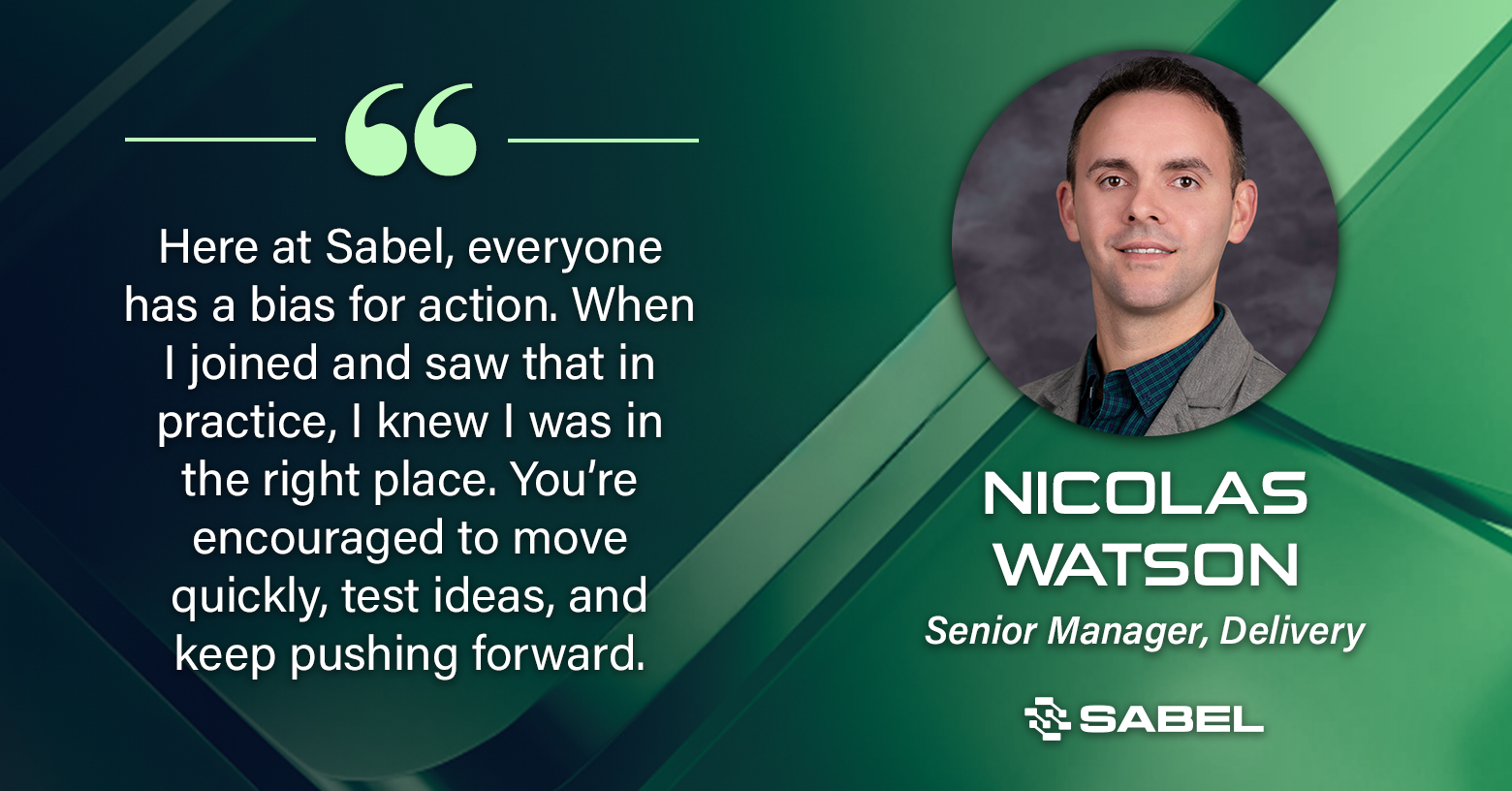
For as long as he can remember, Nicolas Watson has gravitated toward the hard, complex problems that can often be difficult to solve. That instinct shaped his 12-year career as a logistics officer in the U.S. Air Force and continues to define his work today as a Senior Manager of Delivery at Sabel.
Nic’s journey began at the Air Force Academy and evolved into a career focused on large-scale logistics and operations. As commander of the Vehicle Support Chain Operations Squadron, he led a centralized team responsible for managing more than 87,000 vehicles across the Air Force, including procurement, sustainment, and lifecycle oversight.
He also deployed multiple times in support of U.S. military operations, including serving as an Aerial Port Commander at one of the busiest bases in Iraq and Syria and leading Special Operations logistics across the Middle East.
While serving, Nic and his family moved across the country, including Colorado, North Dakota, Virginia, and Ohio. As his family grew to six children, he and his wife made the decision to prioritize long-term stability. After more than a decade of service, Nic separated from the Air Force as a Major and transitioned to the private sector.
 That’s when he began his SkillBridge placement with Sabel in Columbus, Ohio. Prior to that, Nic spent years with the Defense Logistics Agency supporting ground and maritime systems, including leading the stand-up of the Marine Corps’ first retail supply organization at their depots, building and leading a 30+ person team. His ability to “speak military,” combined with deep lifecycle and supply chain expertise, made the transition seamless. Following a successful rotation and his separation from the Air Force, he stepped into managing the Digital Acquisition Environment for the XM30 program and was promoted to Senior Manager last summer.
One of the first major challenges Nic tackled at Sabel was the manual validation of CAD data during critical design review, where reviewing tens of thousands of parts created risk for missed defects and inconsistencies. Nic and the team recognized the need for a better way to process complex outputs and turn them into actionable insights that could accelerate decision-making within the program office.
The millions of data points generated from the review were too large to analyze reliably at pace. TDPWerx addressed this by introducing a more scalable and repeatable approach to validating design data, helping reduce rework and identify issues earlier in the lifecycle. Nic and the team evolved it into a standards-based capability that can adapt as requirements change and support programs across the Department of Defense.
For Nic, this is the kind of work that energizes him. He enjoys working through technical complexity and turning it into solutions that are simple, clear, and actionable. That bias for action is something he carried from the Air Force into civilian life, and one he found aligned well with Sabel’s culture.
“Here at Sabel, everyone has a bias for action,” Nic said. “When I joined and saw that in practice, I knew I was in the right place. You’re encouraged to move quickly, test ideas, and keep pushing forward.”
At Sabel, Nic applies that mindset to help teams work through complex challenges and turn them into clarity that supports faster, more informed decisions.